

Freedom of information · Access to information · Public records
One platform. Any jurisdiction.Built around your own law.
Axcess1 takes every request from intake to release, with your jurisdiction's deadlines, exemptions, letters and reports already in place. AI assists. Authorized officials decide.
Free for 30 days. Hosted by us, on your own servers, or on a single PC or Mac.
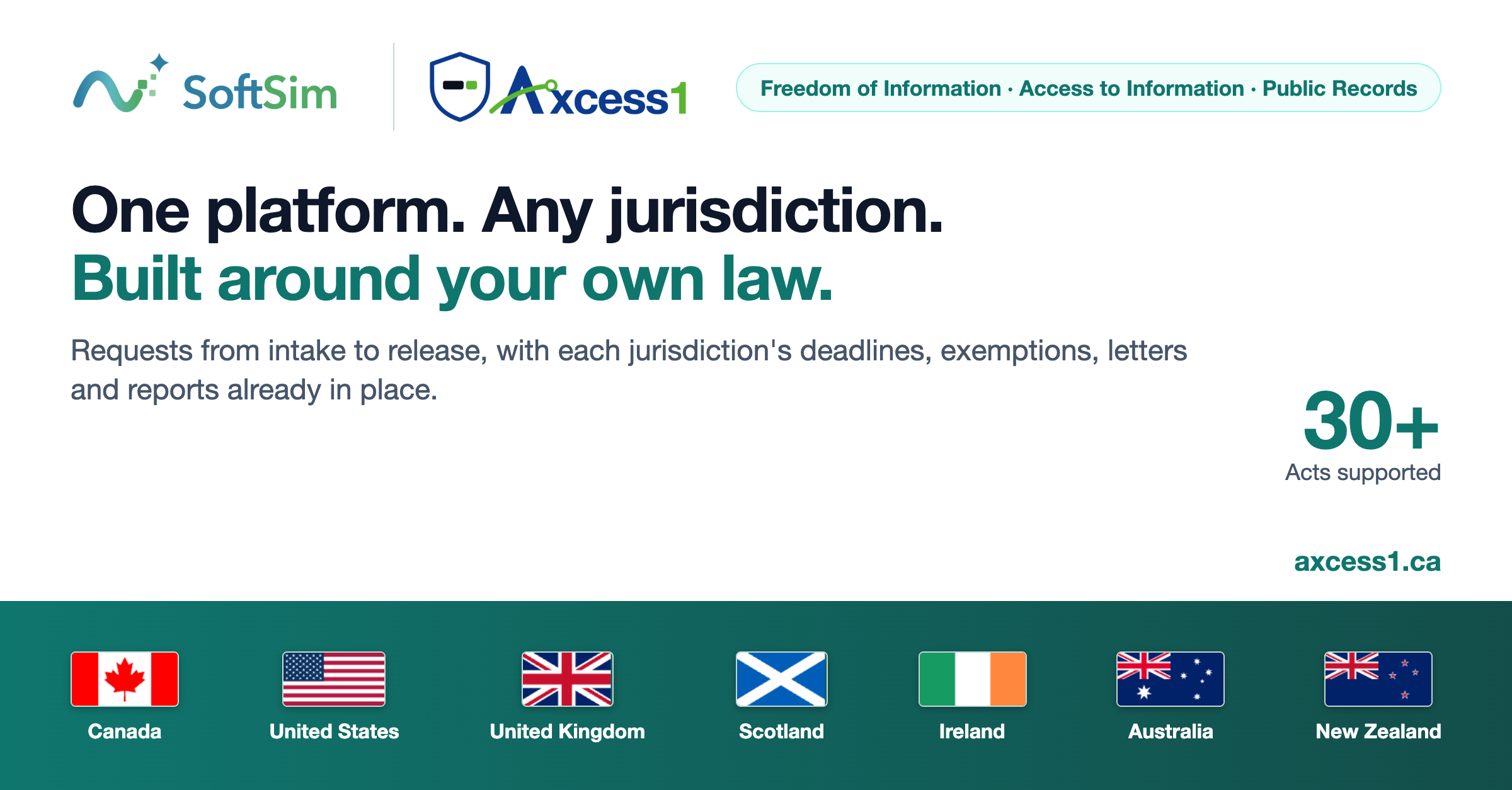
- 30+
- Acts supported
- 7
- jurisdictions
- 3
- ways to run it
- 30
- days free
Built around your law
Choose your Act once. Every deadline, extension, exemption, letter and report then follows it.
Intake to release, in one place
Requests, records, review, redaction, consultations, approval, release and statistics in a single workspace.
AI assists. Officials decide.
Optional AI agents triage requests, review records and suggest exemptions. Nothing is released without a person's approval.
Enterprise FOI and ATIP software, without enterprise software pricing
Starting at C$4,950 a year
- Unlimited users
- No per-user licensing
- No hidden module fees
- Free for 30 days
The price follows the size of your organization and the number of requests it receives, not the number of people who use it. Bring your whole access and privacy team, and the offices you consult, onto Axcess1.
Find Axcess1 for your jurisdiction
 Canada
 Ireland
 Australia
 New Zealand
Seven steps. Every one grounded in statute.
Axcess-1 is not a black-box redaction tool. It is a disciplined legal + workflow + technology pipeline driven by the Access to Information Act and the Privacy Act. Policy rules and legal interpretation decide what is redacted — the software makes those decisions visible, explicit, and defensible.
- Step 01
Ingest & normalise
PDFs, emails, scans, SharePoint, GCDocs — all converted to searchable text. Bad OCR = bad redaction.
- Step 02
Classify & triage
Document type, sensitivity, probable exemptions. Routed to the right officer with the right context.
- Step 03
Apply the legal rules
ATIA s.13-26, exclusions s.68/69/69.1, Privacy Act s.18-28. Mandatory/discretionary flags and injury-test reasoning.
- Step 04
AI-assisted redaction
Claude reads every page; proposes candidates across 15 categories with the right statutory clause. Officer approves.
- Step 05
Irreversible redaction
Underlying text removed, layers flattened, metadata sanitised. No hidden text in the release PDF.
- Step 06
Annotate & justify
Every redaction carries clause, rationale, reviewer identity, timestamp. Full audit trail for Information Commissioner review.
- Step 07
Release package
Redacted PDF + bilingual decision letter + exemption index + TBS statistical entry. A formal legal response.
End-to-end orchestration
Intake → classify → legal rules → AI → redact → annotate → release. One system, one audit trail, one source of truth.
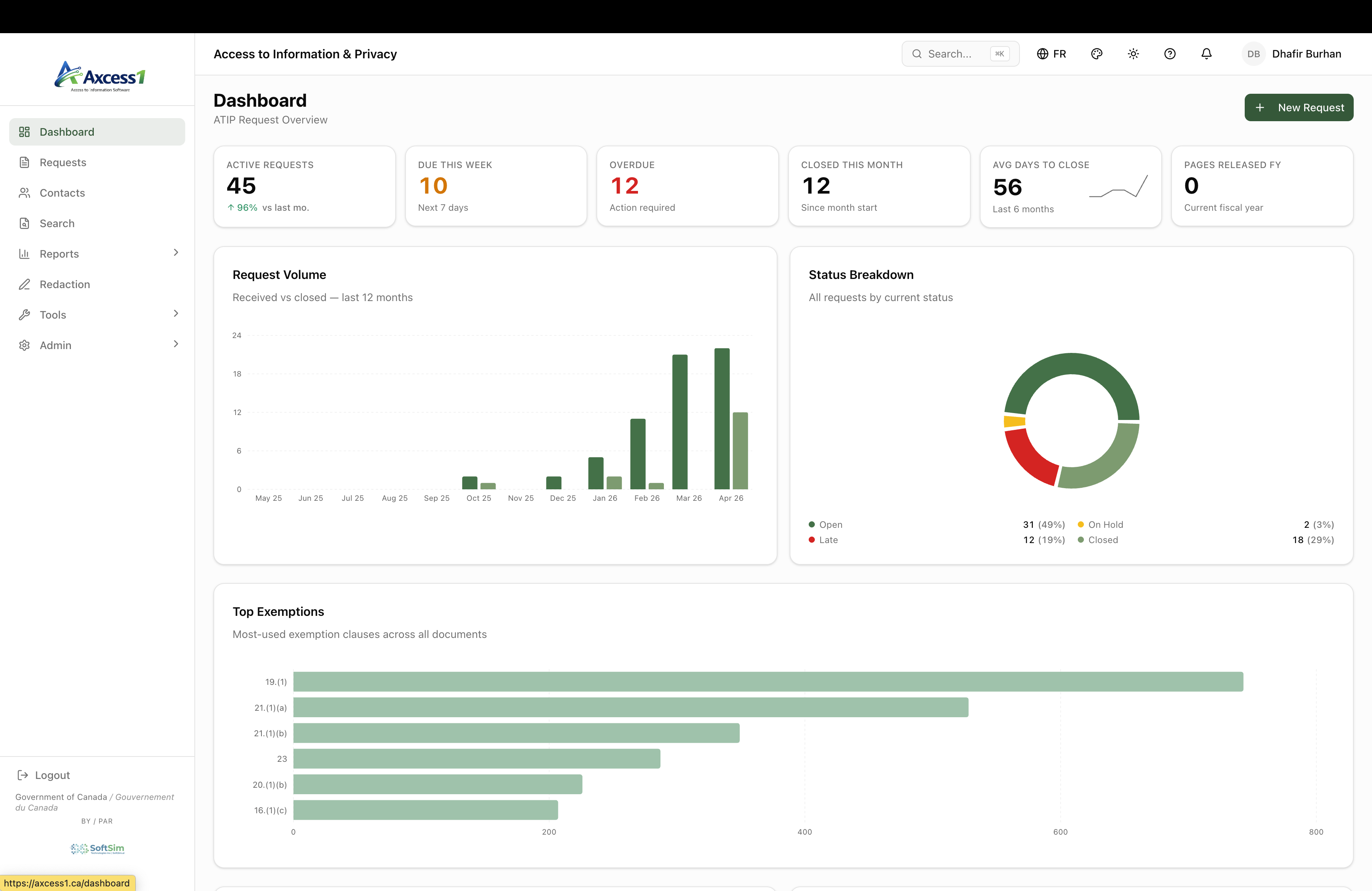
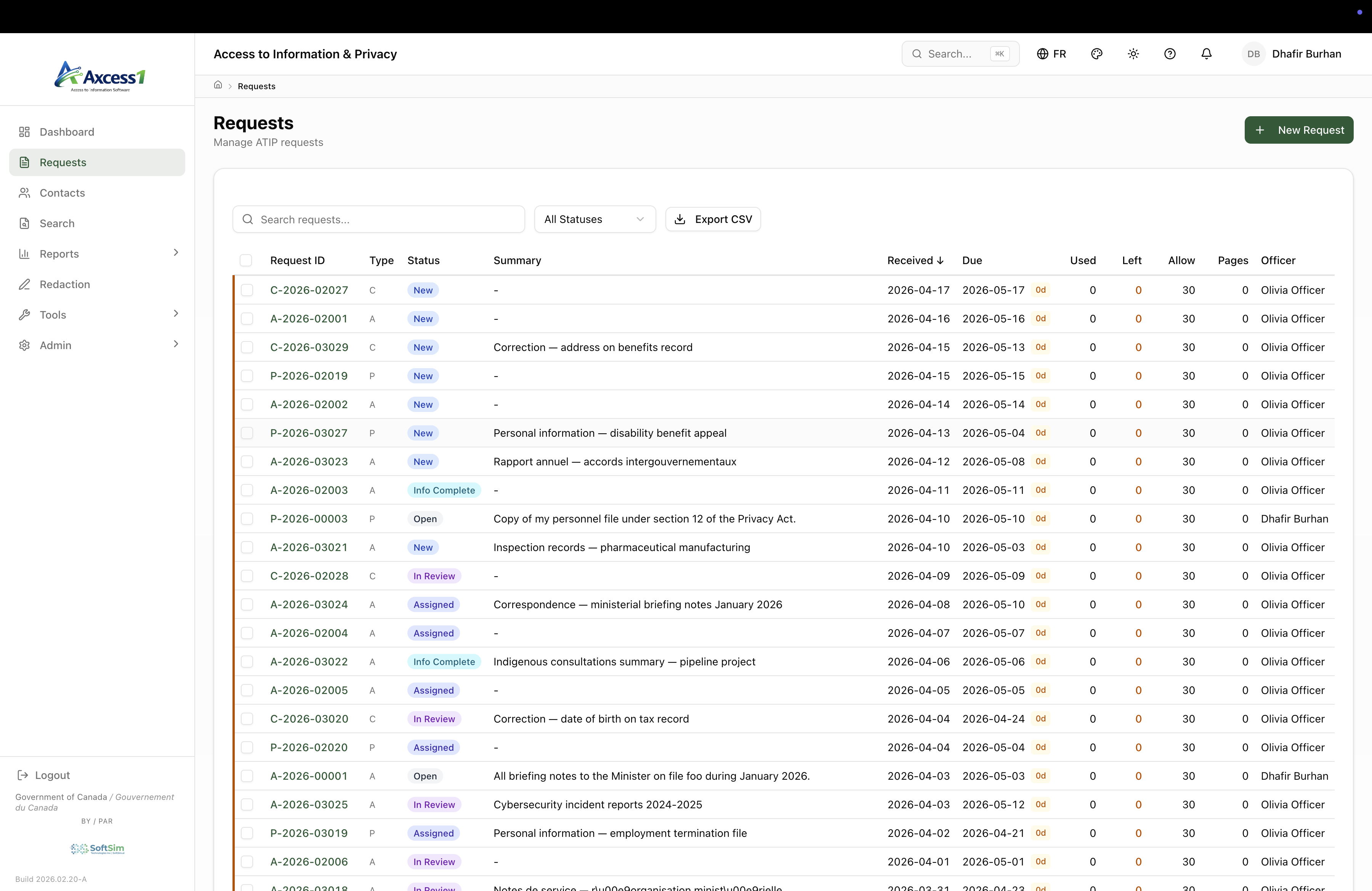
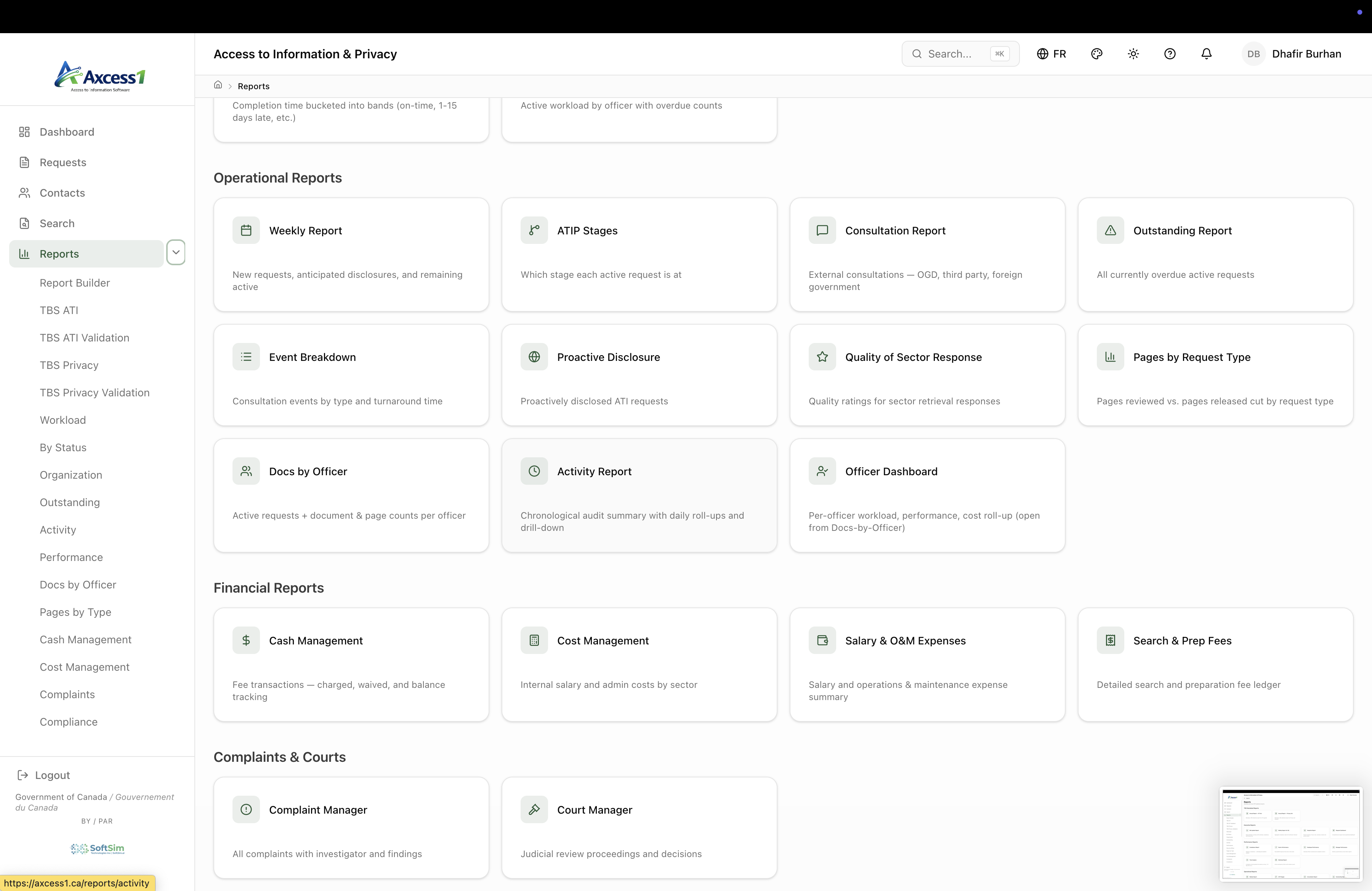
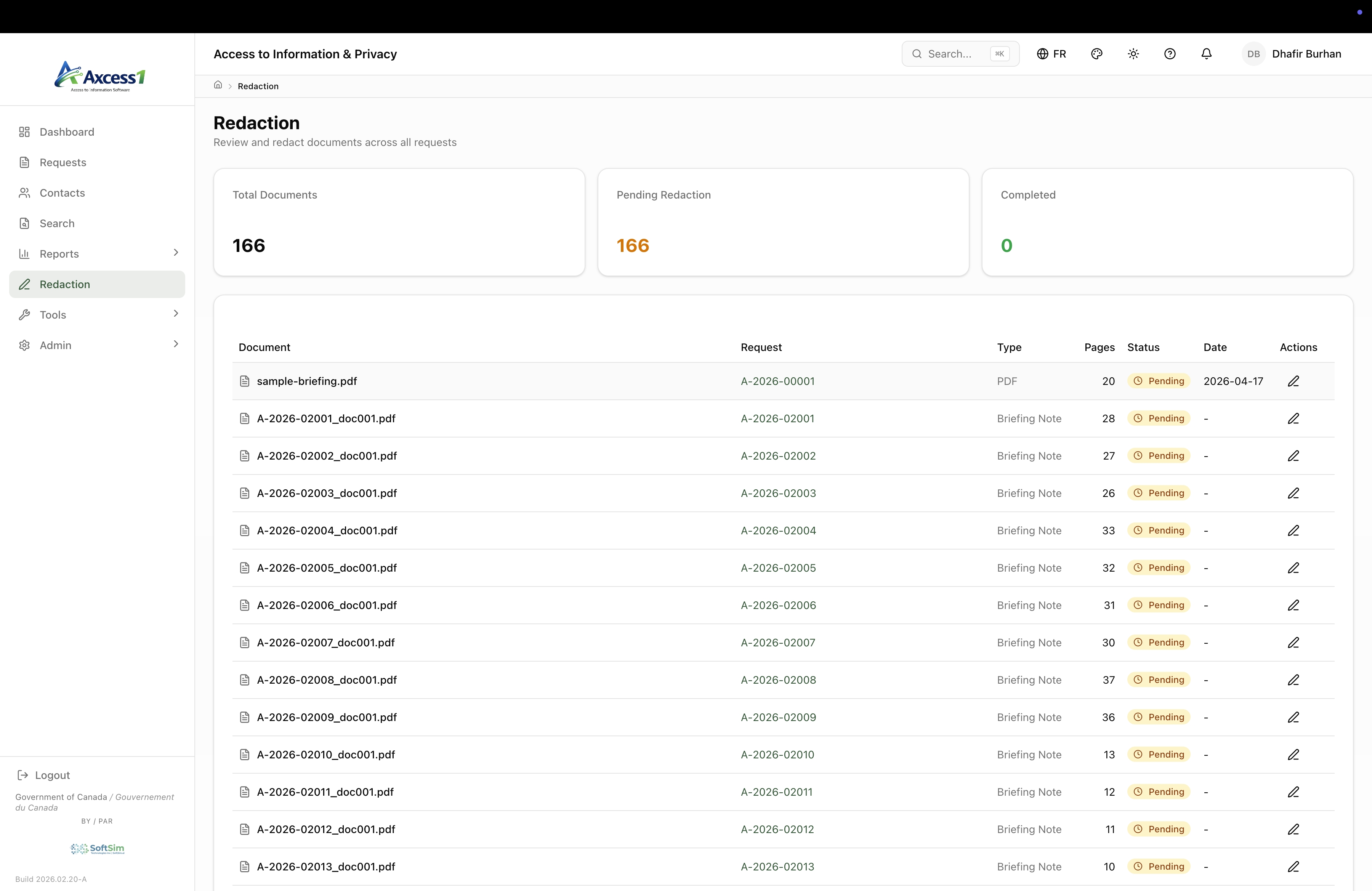
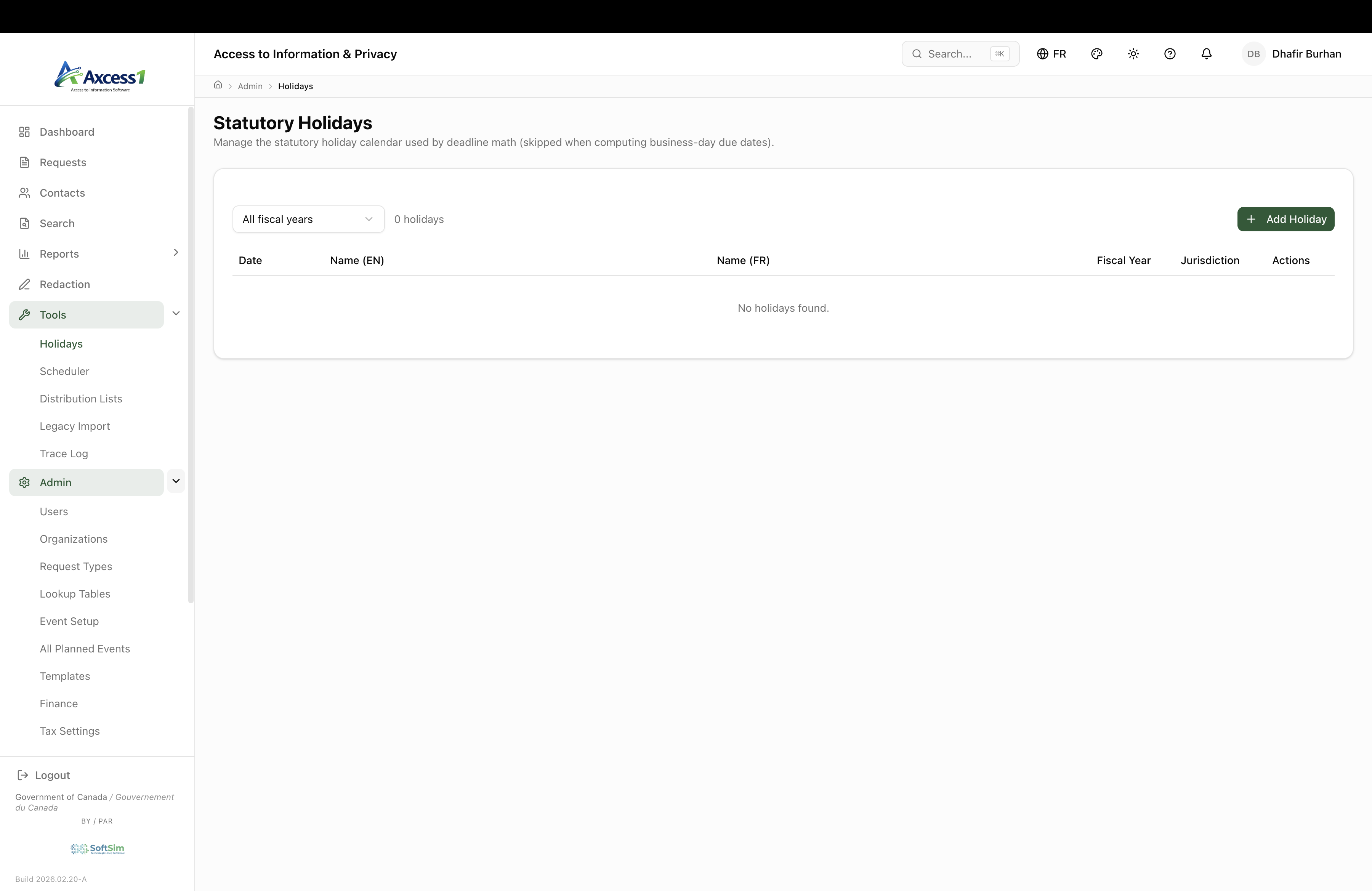
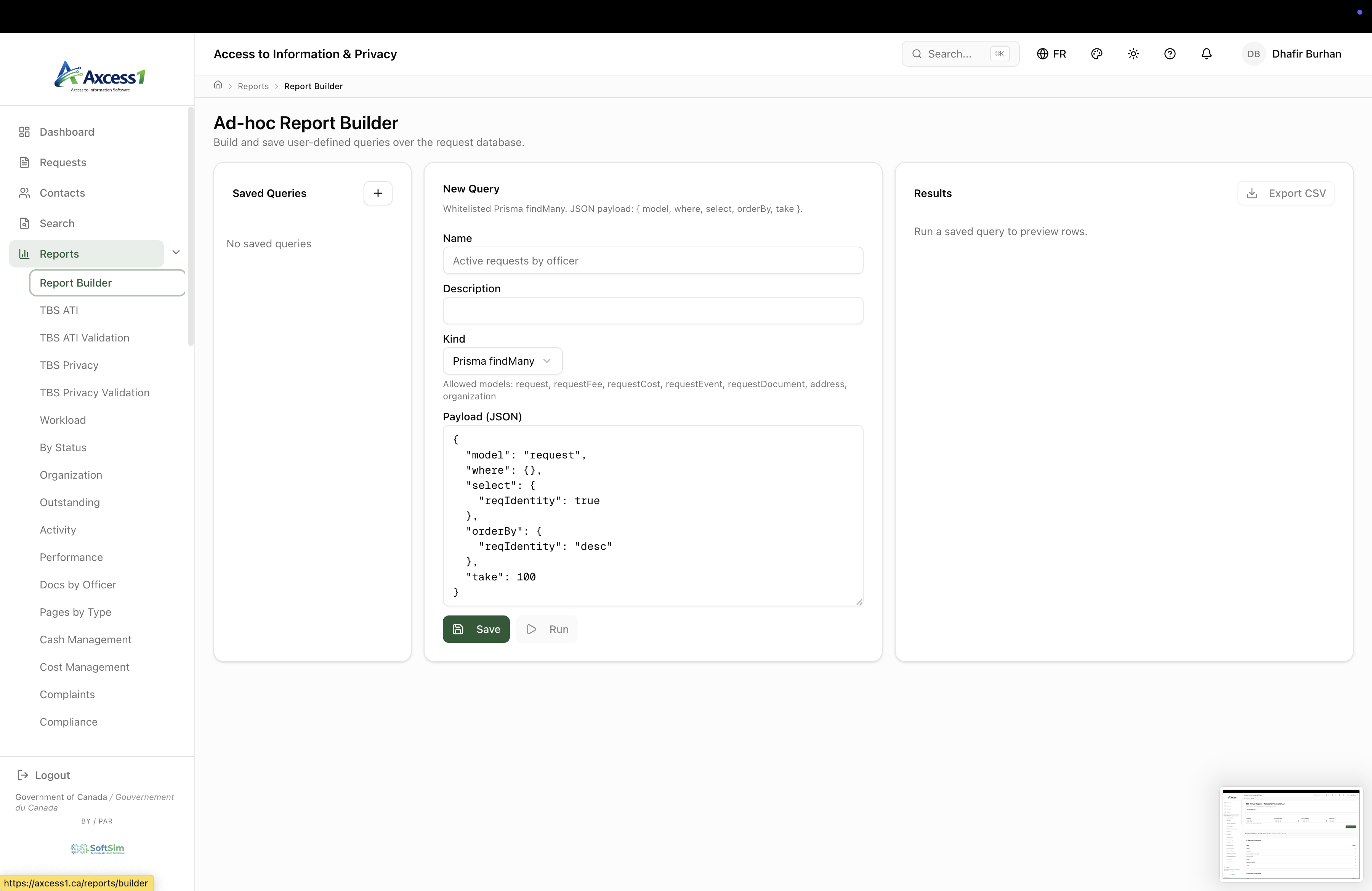
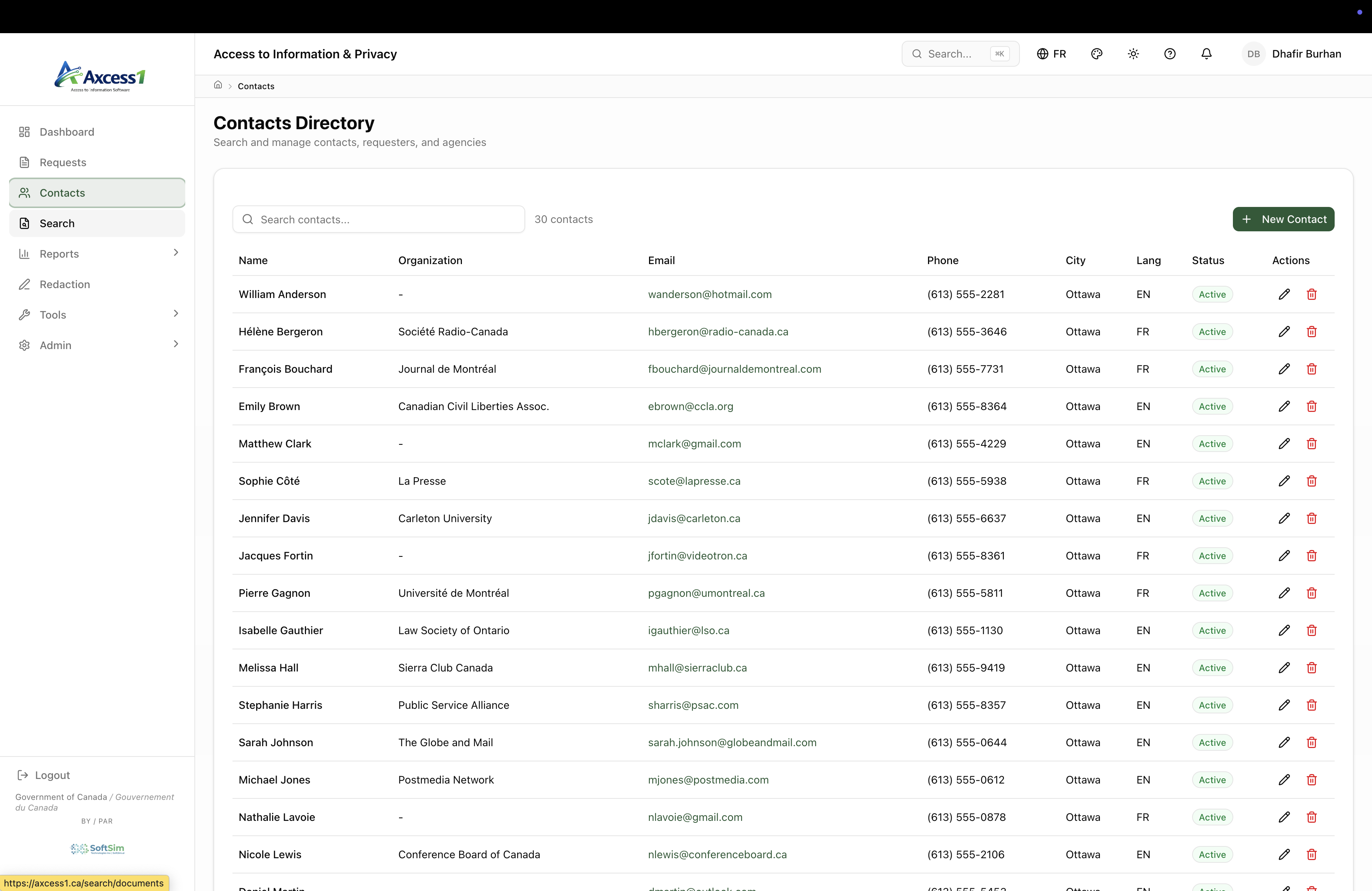
Product tour
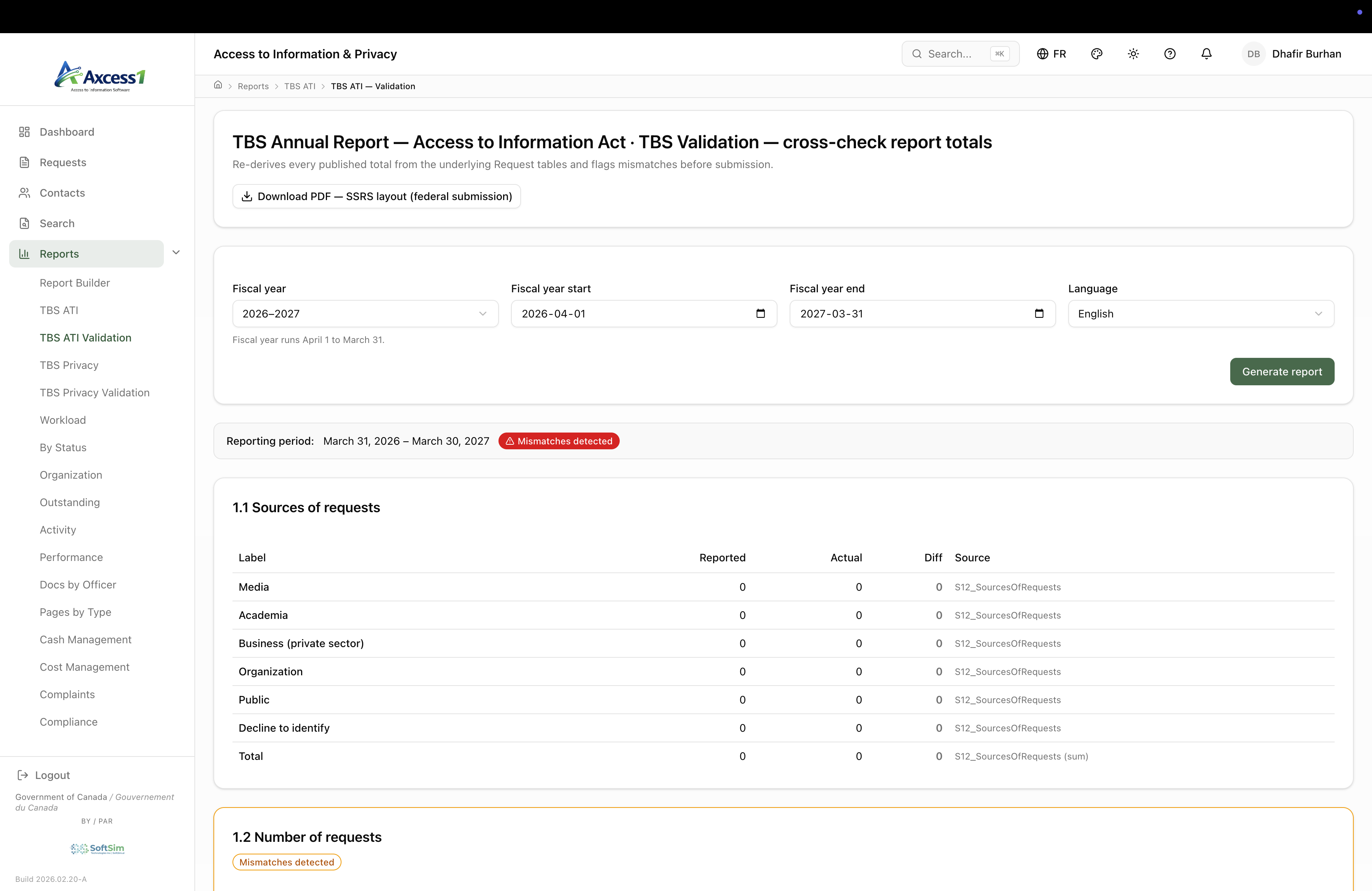
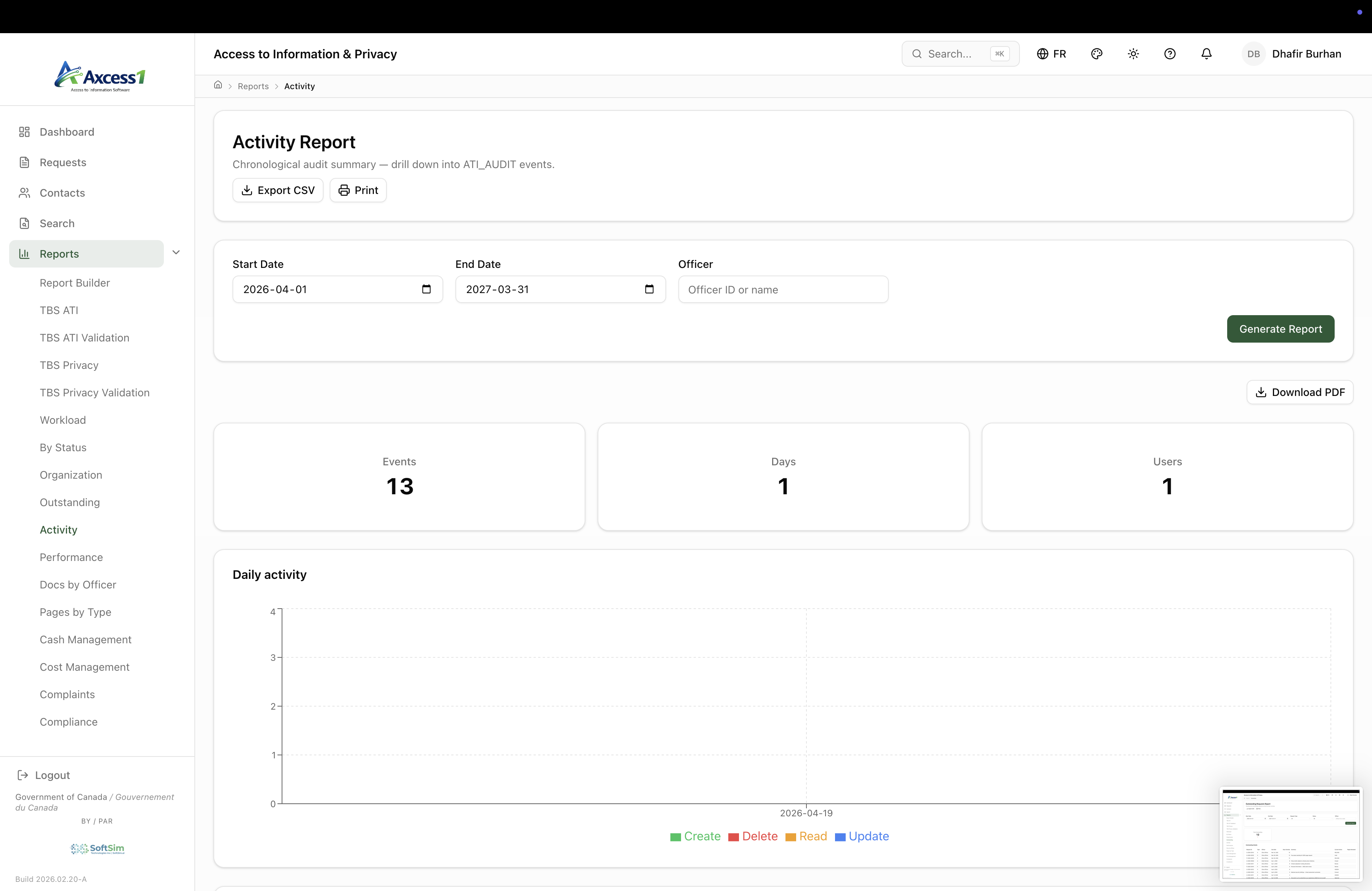
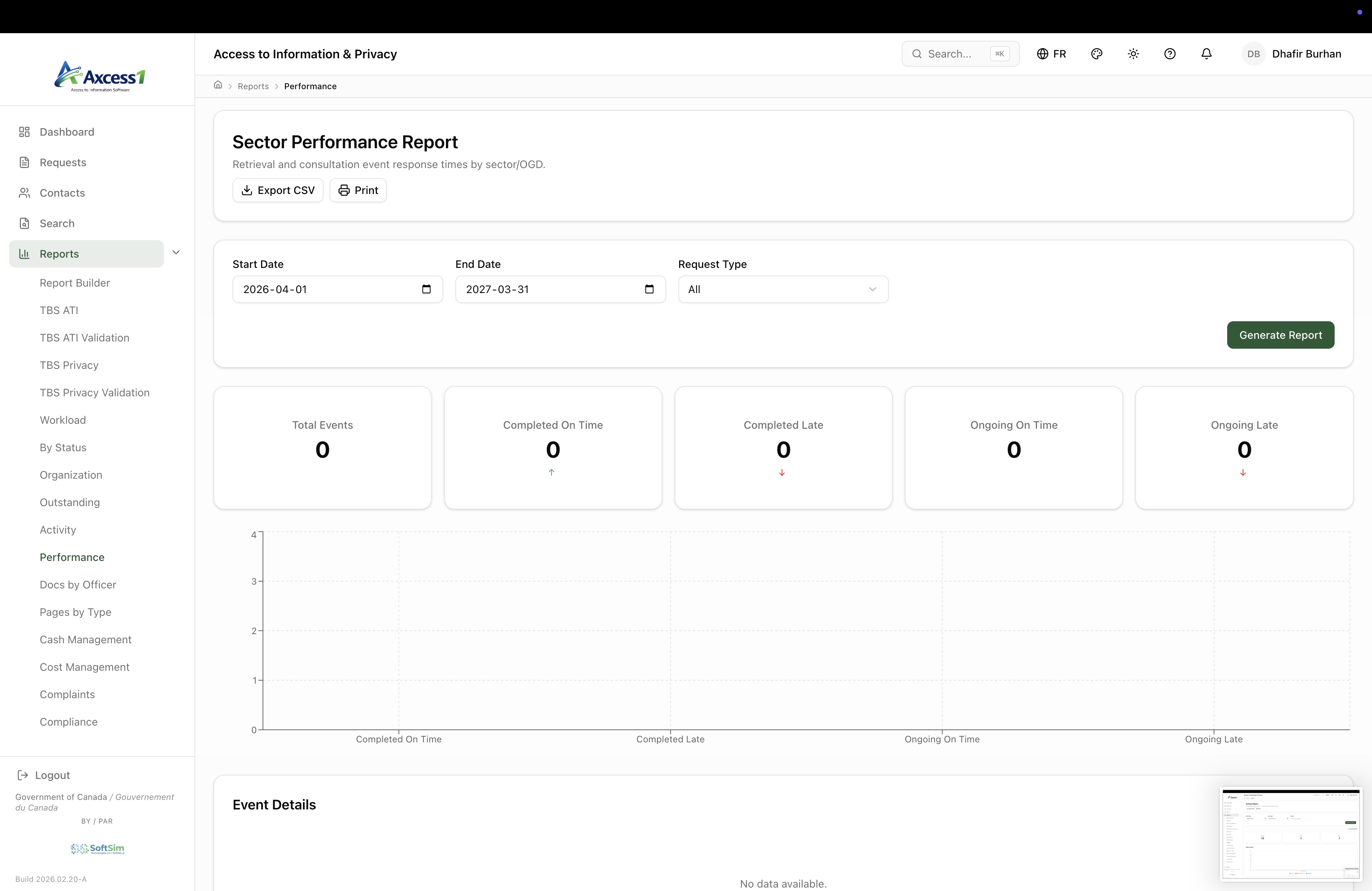
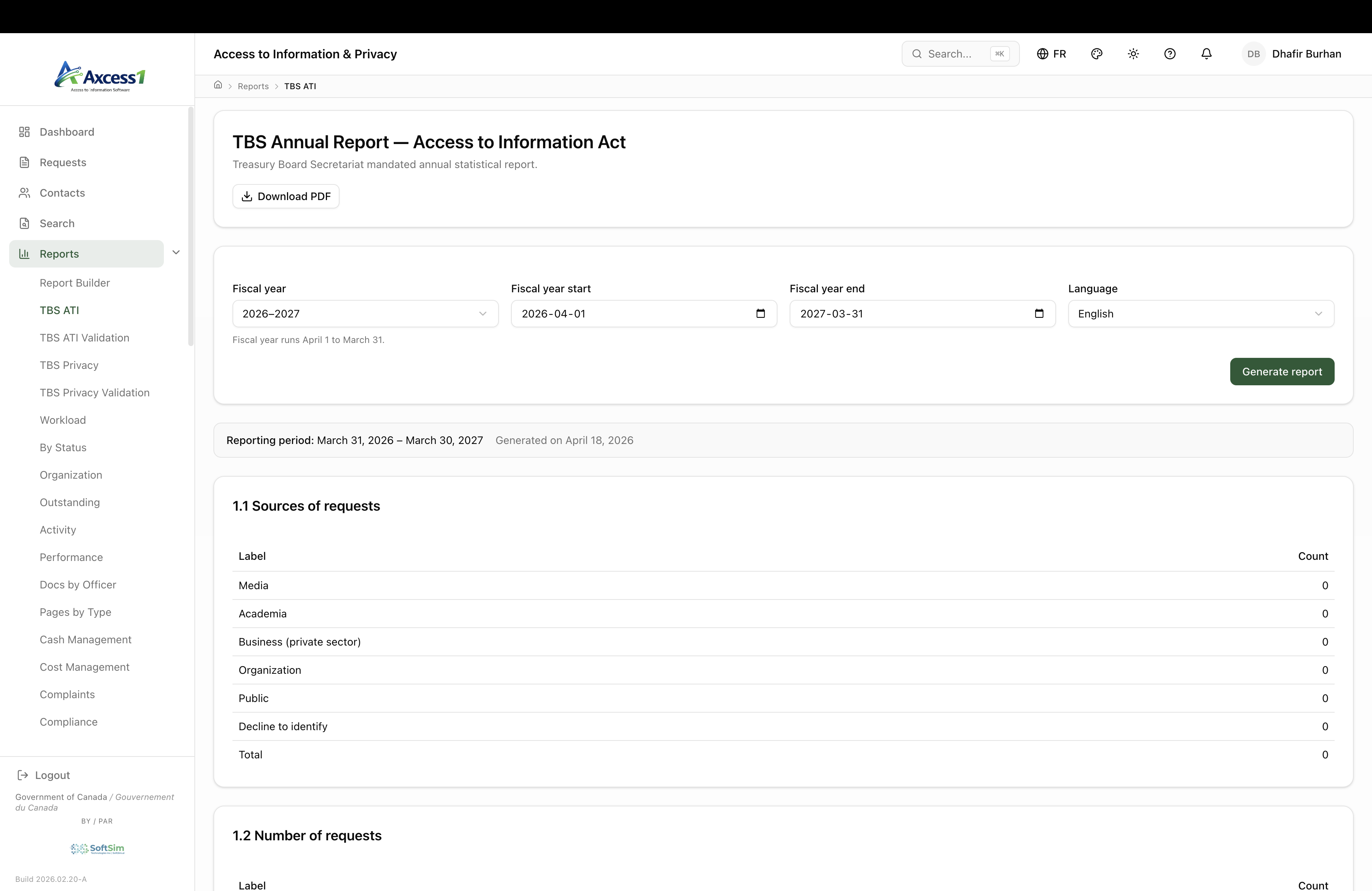
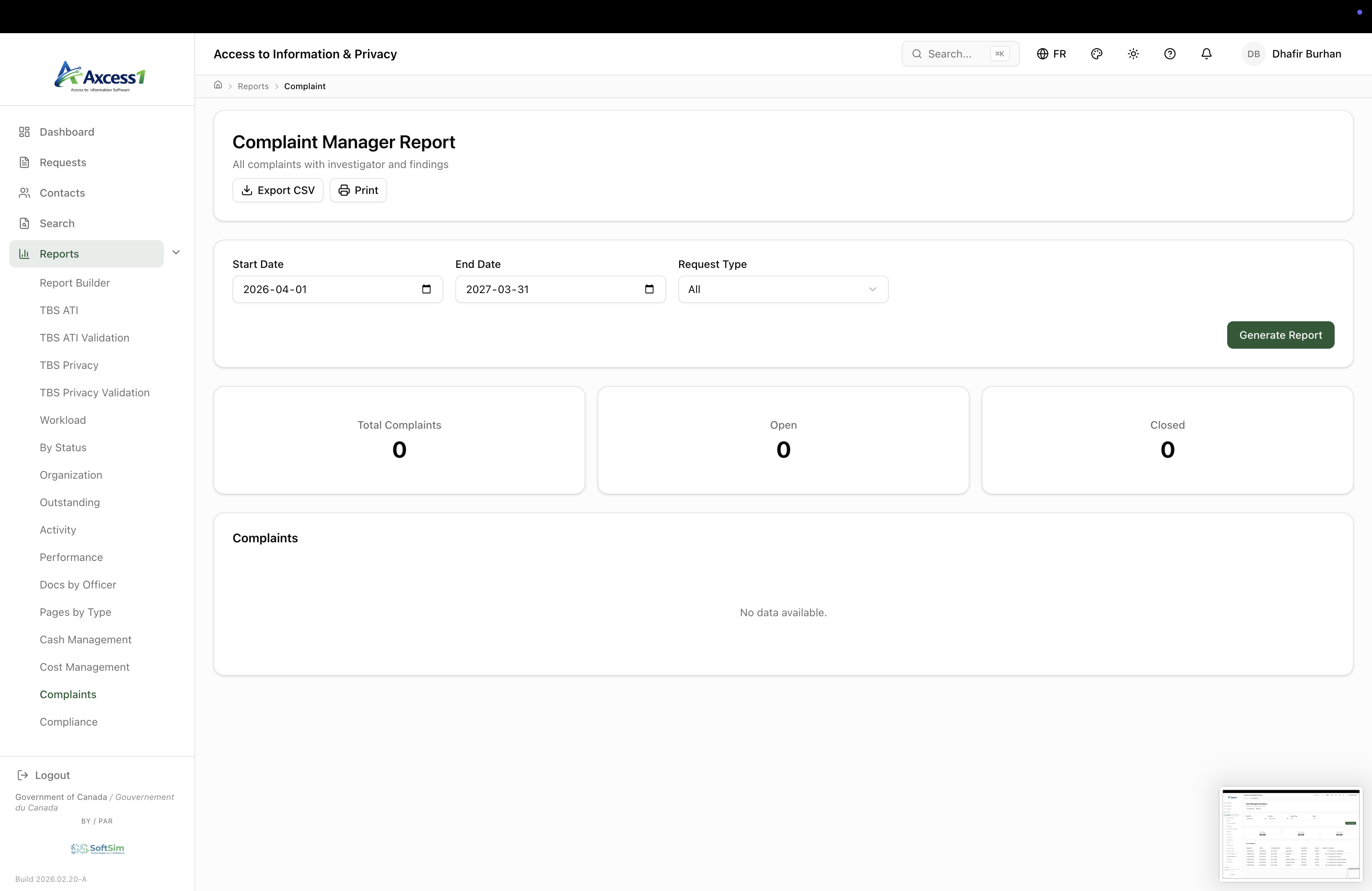
38 live screens — from intake to TBS annual report — in one integrated workspace.
Confidentiality & Security by Default
Engineered for Canadian public-sector data-handling obligations — strict role-based access, cryptographically sealed configuration, tamper-evident audit trails, and retention aligned with Treasury Board guidance.
AES-256-GCM Encryption at Rest
Redactions and bootstrap secrets sealed with AES-256-GCM, PBKDF2-SHA512 (100,000 iterations) and per-record random IVs. No plaintext credentials in the deployment artifact.
Role-Based Access Control
Officer, Administrator, Super-Admin and System roles with org-scoped multi-tenancy — ministries, regions and divisions share a single instance with zero cross-visibility.
Tamper-Evident Audit Trail
Every action logged with user, IP, user-agent, before/after values and timestamp. Queryable from the admin console — ready for Information Commissioner investigations.
Enterprise Authentication
Credentials (bcrypt), LDAP / Active Directory, and SAML-ready. Axcess-1 slots into your existing identity provider — with JWT sessions enriched by role and organisation.
Retention & Disposition
Configurable hold periods (default 7 years per TB ATIP guidance) with automated purge, soft-archive, or hard-delete jobs — every action fully audited.
Reversible, Auditable Redaction
Original pixels are never destroyed. Authorised reviewers can restore or reassign exemption clauses with full audit lineage preserved — supporting Information Commissioner reviews.
Aligned with the Access to Information Act, the Privacy Act, the Policy on Service and Digital, the Directive on Privacy Practices, and TBS guidance on ATIP operations.
More than 30 Acts, each with its own rules
Axcess1 supports the federal Access to Information Act and Privacy Act and the access and privacy Act of every province and territory, including the municipal Acts. It also supports the Acts of the United States, the United Kingdom, Ireland, Australia and New Zealand. Each organization works under its own Act: its provisions, time limits, extensions, notices, fees and letters.
Show every Act and its citation
Canada: federal, provinces, territories and municipalities
| Jurisdiction | Act | Citation |
|---|---|---|
| Canada (federal) | Access to Information Act | R.S.C. 1985, c. A-1 |
| Canada (federal) | Privacy Act | R.S.C. 1985, c. P-21 |
 Alberta Alberta | Access to Information Act | SA 2024, c A-1.4 |
 British Columbia British Columbia | Freedom of Information and Protection of Privacy Act | RSBC 1996, c 165 |
 Manitoba Manitoba | The Freedom of Information and Protection of Privacy Act | CCSM c F175 |
 New Brunswick New Brunswick | Right to Information and Protection of Privacy Act | SNB 2009, c R-10.6 |
 Newfoundland and Labrador Newfoundland and Labrador | Access to Information and Protection of Privacy Act, 2015 | SNL 2015, c A-1.2 |
 Nova Scotia Nova Scotia | Freedom of Information and Protection of Privacy Act | SNS 1993, c 5 |
 Ontario Ontario | Freedom of Information and Protection of Privacy Act | R.S.O. 1990, c. F.31 |
 Prince Edward Island Prince Edward Island | Freedom of Information and Protection of Privacy Act | RSPEI 1988, c F-15.01 |
 Québec Québec | Act respecting Access to documents held by public bodies and the Protection of personal information | CQLR, c. A-2.1 |
 Saskatchewan Saskatchewan | The Freedom of Information and Protection of Privacy Act | SS 1990-91, c F-22.01 |
 Northwest Territories Northwest Territories | Access to Information and Protection of Privacy Act | SNWT 1994, c 20 |
 Nunavut Nunavut | Access to Information and Protection of Privacy Act | CSNu, c A-20 (SNWT 1994, c 20, as duplicated for Nunavut) |
 Yukon Yukon | Access to Information and Protection of Privacy Act | SY 2018, c 9 |
| Nova Scotia municipalities | Municipal Government Act, Part XX — Freedom of Information and Protection of Privacy | SNS 1998, c 18, Part XX |
| Ontario municipalities | Municipal Freedom of Information and Protection of Privacy Act | R.S.O. 1990, c. M.56 |
| Prince Edward Island municipalities | Municipal Government Act — Access to Information and Protection of Personal Information Regulations | RSPEI 1988, c M-12.1, ss. 147–148; PEI Reg EC696/19 |
| Saskatchewan local authorities | The Local Authority Freedom of Information and Protection of Privacy Act | SS 1990-91, c L-27.1 |
Elsewhere, municipalities work under their provincial or territorial Act. A municipality can add its own by-laws and policies as local rules.
Other countries
| Country | Act | Citation |
|---|---|---|
| Australia | Freedom of Information Act 1982 | Act No. 3 of 1982 (Cth) |
| Australia | Privacy Act 1988 | Act No. 119 of 1988 (Cth), Schedule 1 — Australian Privacy Principles 12 (access) and 13 (correction) |
| Ireland | Freedom of Information Act 2014 | No. 30 of 2014 |
| Ireland | General Data Protection Regulation and Data Protection Act 2018 (right of access, Art. 15) | Regulation (EU) 2016/679; No. 7 of 2018 |
| New Zealand | Official Information Act 1982 | 1982 No 156 |
| New Zealand | Privacy Act 2020 | 2020 No 31 |
| New Zealand (local government) | Local Government Official Information and Meetings Act 1987 | 1987 No 174 |
| New Zealand (local government) | Privacy Act 2020 | 2020 No 31 |
 United Kingdom United Kingdom | Freedom of Information Act 2000 | 2000 c. 36 |
| United Kingdom | UK GDPR and Data Protection Act 2018 (right of access, Art. 15) | Regulation (EU) 2016/679 as retained in UK law; 2018 c. 12 |
 United Kingdom — Scotland United Kingdom — Scotland | Freedom of Information (Scotland) Act 2002 | 2002 asp 13 |
| United Kingdom — Scotland | UK GDPR and Data Protection Act 2018 (right of access, Art. 15) | Regulation (EU) 2016/679 as retained in UK law; 2018 c. 12 |
 United States United States | Freedom of Information Act | 5 U.S.C. § 552 |
| United States | Privacy Act of 1974 | 5 U.S.C. § 552a |
| United States — California | California Public Records Act | Cal. Gov. Code § 7920.000 et seq. (Division 10 of Title 1; recodified by Stats. 2021, ch. 614, operative January 1, 2023) |
| United States — Florida | Public Records, Chapter 119, Florida Statutes | Chapter 119, Florida Statutes (2026); Art. I, s. 24, Florida Constitution |
| United States — New York | Freedom of Information Law | N.Y. Public Officers Law, Article 6, §§ 84-90 |
| United States — Texas | Texas Public Information Act | Tex. Gov't Code ch. 552 |
| United States — Virginia | Virginia Freedom of Information Act | Code of Virginia § 2.2-3700 et seq. |
Explore Axcess1 in depth
Open a topic to see the detail.
Features
Purpose-Built for ATIP Compliance
Every feature designed to meet the demands of federal access to information and privacy legislation.
Request Management
Track ATIP requests from intake to completion with automated deadline calculations, extension tracking, and status workflows.
AI-Powered Redaction
Intelligent document redaction with AI-powered PII detection, clause suggestion, and confidence scoring across 130+ exemption clauses.
Exemption Clauses
Complete library of Access to Information Act and Privacy Act exemption clauses with bilingual support (EN/FR).
Deadline Tracking
Automated due date calculations accounting for business days, extensions, and hold periods. Visual indicators for at-risk requests.
TBS Reporting
Generate Treasury Board Secretariat statistical reports automatically. Track disposition codes and processing metrics.
Audit Trail
Complete event logging for every action. Track status changes, document reviews, fee assessments, and officer assignments.
AI-assisted redaction
AI That Knows What to Redact — and Why
Axcess-1's AI reads every page of every document, identifies which information is a candidate for redaction, maps each finding to the correct Access to Information Act or Privacy Act clause, and explains its reasoning. Officers stay in control — every suggestion is reviewable, reversible, and fully audited.
15 categories of redaction candidates, detected automatically
Word-Box Precision
Every detection is tied to exact OCR word-box coordinates on the page. The AI does not guess — it points to the pixels that must be masked, ready for one-click or bulk application.
Clause Auto-Mapping
Each candidate is mapped to the exact statutory clause — s.13 through s.26 of the ATIA, equivalent sections of the Privacy Act — with mandatory vs. discretionary flag and injury-test reasoning.
Confidence Scoring
Every suggestion carries a confidence score. Officers can auto-apply high-confidence PII (like SIN or phone), review medium-confidence items, and escalate anything ambiguous to a senior reviewer.
Reasoned Explanations
Hover any AI suggestion to see the model's reasoning in plain language — why this is third-party personal information, why this warrants s.19(1), why an injury test applies. No black box.
Corpus-Wide Consistency
The AI runs across every document in a request in a single pass, deduplicates entities, and ensures the same person, file number, or commercial secret is redacted the same way across thousands of pages.
Officer Always in Control
AI proposes — an officer approves. Every accepted, modified, or rejected suggestion is audited with the reviewer's identity and reasoning. Original pixels are never destroyed; decisions remain reversible.
AI agents
Agentic-AI Workflow Automation
Axcess-1 goes beyond single-shot AI suggestions. Purpose-built AI agents orchestrate every stage of the ATIP lifecycle — classifying, retrieving, redacting, consulting, packaging, reporting — with a human approval gate at every decision point. Officers review, approve, or override; the system executes and audits.
Intake & Triage Agent
Reads the incoming request letter, classifies it as ATI or Privacy, extracts the requester and subject-matter scope, assigns to the right unit, and drafts a bilingual acknowledgment letter for officer signature.
Retrieval & OCR Agent
Queries GCDocs, SharePoint, OneDrive, and file shares based on the request scope; deduplicates via SHA-256; runs bilingual OCR; and ingests responsive documents into the case file with full provenance.
Redaction Analyst Agent
Runs the AI redaction intelligence across every page, proposes candidates with statutory clauses and confidence scores, and stages them in the review queue for officer approval — never auto-applied without sign-off.
Consultation Agent
Identifies documents requiring consultation with OGDs or third parties, drafts the outgoing consultation package and cover letter, tracks return dates, and reconciles responses back into the case file.
Deadline Monitor Agent
Watches every request against its statutory clock. Flags at-risk files, suggests 9(A)/(B)/(C) or 15(A1)/(A2)/(B) extensions with the required justification, and drafts the extension notification letter.
Release Packager Agent
Assembles the final release PDF — cover page, bates numbering, per-document overrides, redaction summary, exemption index — and drafts the bilingual cover letter for the officer's review.
TBS Reporter Agent
At period close, drafts the full Treasury Board statistical report for both Acts, runs the validation engine, surfaces every anomaly, and presents a submission-ready PDF for the coordinator's sign-off.
Correspondence Agent
Drafts every outgoing letter — acknowledgment, fee, extension, consultation, interim release, final release, clarification — in the recipient's official language, from live case-file data.
Human-in-the-Loop, Always
Every agent action is a proposal, not a decision. Officers approve, modify, or reject — and every step is audited with identity, timestamp, and reasoning. No agent ever sends a letter, applies a redaction, or closes a request without a human sign-off.
Built for the Government of Canada's AI guardrails
Every agent runs within the same audit, retention, and access-control envelope as the rest of Axcess-1. Agents can be enabled, disabled, or scoped per organisation from the admin console. AI reasoning and every agent action are logged — supporting the Directive on Automated Decision-Making, the Algorithmic Impact Assessment, and internal AI-use reviews.
Integrations
Works With Your Existing Document Systems
Axcess-1 ships as one configurable binary. An administrator signs into the bootstrap console and picks the storage, OCR, AI, email and authentication providers. No code changes, no rebuilds, no hard-coded vendors.
GCDocs
Native connector to the Government of Canada's enterprise content management platform. Retrieve records, ingest responsive documents, and write the final release package back to GCDocs with full provenance.
Microsoft SharePoint
Ingest responsive records directly from SharePoint sites and document libraries via the Microsoft Graph API — with OAuth2 app-only credentials and granular site-scoped permissions.
Microsoft OneDrive
Pull officer and stakeholder files from OneDrive for Business — same Microsoft Graph foundation as SharePoint, with per-user delegated or app-only flows.
AWS S3 & Azure Blob
Sovereign-region S3 and Azure Blob storage supported out of the box. Use customer-managed keys (KMS / Azure Key Vault) to keep encryption material under your exclusive control.
PostgreSQL & SQL Server
Run on PostgreSQL or Microsoft SQL Server — a unified data layer keeps both engines in lock-step so you can migrate without rewriting queries or losing legacy integrations.
Legacy Editor Interop
Reads the existing C/C++ Editor's Scan / Markup / ReleasePDF folder layout and its .rects, .erma and .axc sidecar files — plug-and-play with installations already in production.
Bilingual OCR (EN / FR)
Tesseract (self-hosted) with English and French language packs, or AWS Textract. Every scanned page is indexed and searchable across the entire request.
Vendor-Agnostic AI
Anthropic Claude by default — or bring your own model, route through a sovereign Canadian endpoint, or run disabled. Configured in the admin console without code changes.
Email: SMTP & AWS SES
Acknowledgment, extension, fee, and final-release letters sent via SMTP or AWS SES — or disabled entirely for fully air-gapped deployments.
Statistical reports
Every Treasury Board Statistical Report — Built In
Axcess-1 produces the full set of Treasury Board statistical reports for the Access to Information Act and the Privacy Act, with a built-in validation engine that re-derives every aggregate from raw data and flags any discrepancy before you submit.
Statistical Report Sections
PDF (SSRS pixel-parity) & Excel export · Built-in validation
- § 1.1
- Sources of requests
- Media, Academia, Business (private sector), Organisation, Public, Decline to identify.
- § 1.2
- Number of requests
- Received, outstanding from previous period, closed during period, carried forward.
- § 2.1
- Disposition and completion time
- Disposition codes crossed with statutory day-buckets (1–15, 16–30, 31–60, 61–120, 121–180, 181–365, 365+).
- § 2.2
- Exemptions invoked
- Counts per ATIA / Privacy Act section cited across every closed request — including every subsection.
- § 2.3
- Exclusions cited
- Records excluded under s.68, s.69, s.69.1 (ATIA) or equivalent Privacy Act provisions.
- § 2.4
- Format of information released
- Paper, Electronic, Examined on premises, Other.
- § 2.5
- Other complexities
- Consultation required, Assessment of fees, Legal advice sought, Other.
- § 2.6
- Reasons for not meeting the statutory deadline
- Workload / interference, External consultation, Translation, Other — with day-range distribution.
- § 3.1
- Extensions claimed
- ATIA: 9(A), 9(B), 9(B)(i), 9(B) Historical OGD, 9(C). Privacy Act: 15(A1), 15(A2), 15(A2) Historical OGD, 15(B). Count, total days, average days, longest.
- § 4
- Fees
- Application and search fees collected; fees waived / refunded; net fees — aggregate and by range.
- § 5
- Consultations received from other institutions
- Count received, count closed, pages reviewed — with disposition of each consultation.
- § 6
- Resources
- Salary costs, Goods & services, Professional services, FTE estimate.
- § 7
- Complaints and investigations
- Received, closed, well-founded findings — broken out by disposition.
- § 8
- Court action
- Applications filed, decisions rendered, judgments issued.
Accessibility
Designed for Every User, in Both Official Languages
Axcess-1 treats English and French as first-class, not as a translation afterthought. Every screen, letter template, and report honours the user's language preference — including the OCR engine, which reads both languages natively.
Full EN / FR Interface
All labels, menus, tables, error messages — including login — switch in a single click. The user's langPref is persisted per profile and honoured across sessions.
Keyboard-First Navigation
Redaction canvas, menus, dialogs, and table navigation — no mouse required. Shortcut keys for every frequent action on the case file.
ARIA & Assistive Technology
Labels, descriptions, and live regions throughout — built on Radix UI primitives and tested with screen readers. Focus management respects WCAG 2.1 guidance.
High-Contrast & Dark Modes
Respects system forced-colors settings; dedicated dark and high-contrast themes; print stylesheets tuned for low-vision output.
Global Search & Skip Links
Skip-to-content on every page, command-palette global search across requests and documents, and consistent breadcrumbs — navigation that stays predictable as the workload grows.
Bilingual Document Processing
OCR language packs for English and French; search and AI analysis work across both without extra configuration. Letter templates render in the recipient's official language.
The Canadian alternative
The Canadian alternative to US-owned ATIP software
Many federal institutions run their ATIP offices on platforms owned by companies in the United States. Ownership brings jurisdiction — software controlled by a US company can be subject to US law, including the CLOUD Act. Canadian institutions can keep one of their most sensitive functions under Canadian control. Axcess1 is Canadian-owned, built and supported in Canada, and runs where your department decides — at a fraction of the cost of traditional enterprise ATIP software.
Canadian-owned
Built, owned and supported in Canada, under Canadian law.
Your data, in Canada
Your servers, your approved cloud or Canadian hosting — and private AI on your own servers.
Easy to switch
SoftSim migrates your case history and documents from your current ATIP system, including US-owned platforms and legacy Axcess-1.
About SoftSim
Modernizing ATIP Processing
Axcess-1 replaces legacy desktop-based ATIP systems with a modern web application. Built with security, bilingual compliance, and operational efficiency at its core, it helps ATIP offices process requests faster while maintaining full regulatory compliance.
Day statutory deadlines tracked
Exemption clauses supported
AI-powered redaction engine
See Axcess1 working with your own Act
Thirty minutes, with your legislation and your workflow. Then try it free for 30 days.